The Argument for
the Human Head:
Petrides’ Heads
in Context
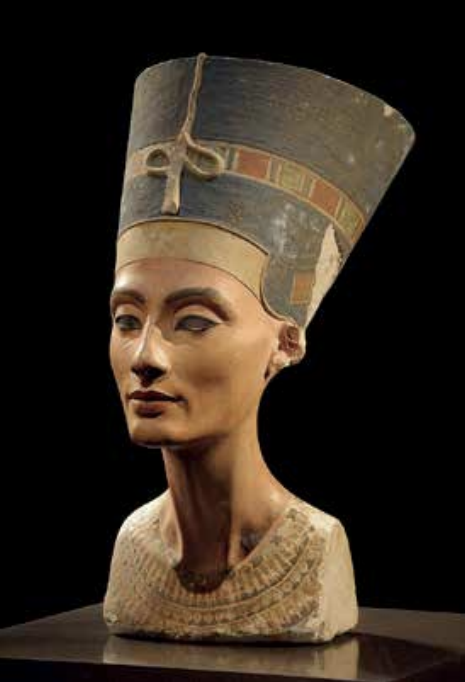
Nefertiti Bust, New Kingdom, 18th
Dynasty, ca. 1351–1334 BC, Egypt,
Tell el-Amarna. Neues Museum,
Berlin. Photo by Philip Pikart.
Phidias and the Civic Body
With Phidias’s Parthenon pediment sculptures (5th century BC), even a non-human head can be an instrument of the polis and its myths. Almost all the carved heads of the in-the-round figures have been lost to damage or theft, so the Head of a horse of Selene from the east pediment stands in as our proxy. It depicts one of the horses of the moon goddess Selene sinking below the horizon at the dawn of Athena’s birth.² The sculpture’s force lies in its physical realism—ears flattened back, flared nostrils, bulging eyes, veins, and a gaping jaw convey pure, animal exhaustion after a long night’s work—yet through this animal head, the excellence and intelligence of the sculptor are unmistakably present.³
Hellenic Heads shares this use of the head as a carrier of narrative but reverses the logic. Phidias’s horse captures one mythic instant of fatigue; Petrides' human heads are defined not by a single moment but by the accumulated weight of decades. The works represent a procession of generations, from an Asia Minor grandmother who fled the burning of Smyrna in 1922, through parents shaped by occupation and civil war in the 1940s, to the artist himself and a daughter who may inherit a different story. In Phidias, the head confirms a shared myth. In Petrides, the head registers the private experience of national myths: as unease at the dinner table, as a grandmother’s silence, as a parent’s frugal caution born of wartime shortages and persecution, but also as faith in work, education, and continuity. Both bind the individual to history, but where the Parthenon dramatizes a visible divine and civic drama, Hellenic Heads reveals the weight of what is carried inward.
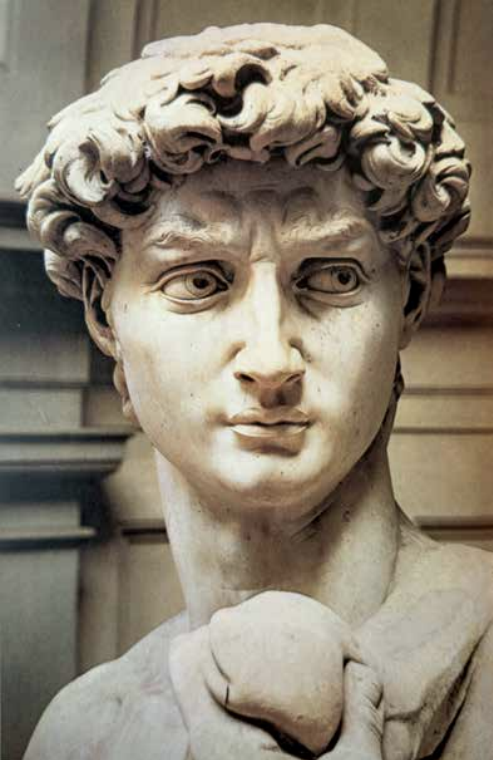
Detail of the head of David. White
marble sculpture by Michelangelo
Buonarroti, 1501–1504. Galleria
dell Accademia di Firenze. Source:
The Art of Michelangello, Optimum
Books, 1981.
Rodin: The Anti-Monument
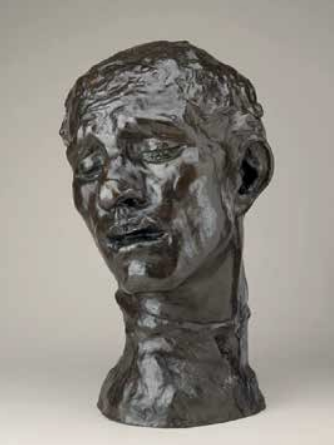
Auguste Rodin’s studies for The Burghers of Calais (1884–1889), particularly the individual heads, function as “anti-monuments”. The Monumental Head of Pierre de Wissant shows a figure absorbed in his own thoughts. Rodin rejected heroic convention; instead of the confident, noble faces typical of 19th-century civic monuments, he portrayed the men as “troubled, isolated individuals in anguish,” giving them slumping postures and emotionally tortured features. The “emotionally tortured face” and “anguished expression” of de Wissant make the figure’s inner suffering and "extreme distress" visible as he faces his own sacrifice.⁶
Petrides' heads share with Rodin the conviction that public sculpture can show hesitation and doubt rather than simple heroism. This connection is foundational; Petrides has explicitly cited the Burghers as an "anti-monument to the civilian who was suffering" and a direct conceptual precedent for his own work. Each of Petrides' figures is a kind of burgher, carrying the weight of decisions made elsewhere but experiencing them as ration lines, disappearances, or relocations. The difference in format matters. While the final Burghers monument places these figures mid-step, Rodin’s isolated head studies contain the entire crisis. Petrides freezes this motion entirely. His heads do not move through time so much as contain time. The “crisis” is not a single sacrifice but the sustained anxiety of living with inherited fear and learned caution—and the quiet courage of getting on with ordinary life. Both complicate commemoration, but Rodin’s drama is public and historical, while Petrides' is familial and psychological.
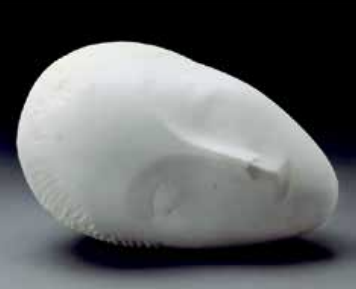
The marble version of Sleeping Muse
(1909) by Constantin Brancusi. Hirshhorn
Museum, Washington, D.C. Brancusi cast
several of the sculptures in bronze, which
are now in museums around the world,
including the Metropolitan Museum of Art
in New York City, the Musée National d'Art
Moderne in Paris, and the Art Institute of
Chicago.
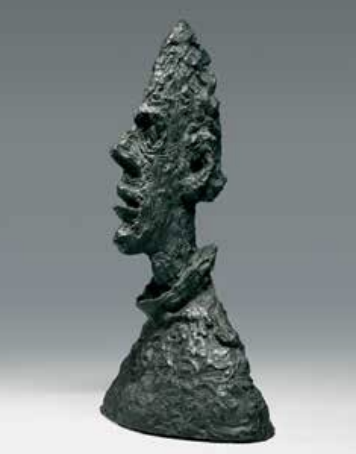
Grande tête mince (Large Thin Head),
1954. Bronze sculpture by
Alberto Giacometti.
Bourgeois: The Psyche as Monument
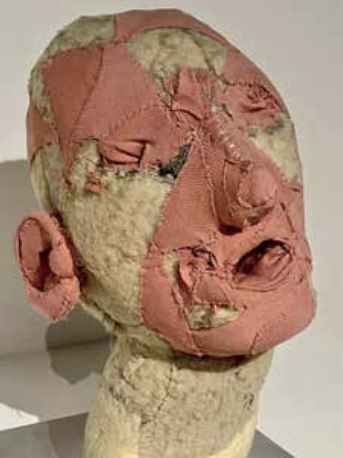
Louise Bourgeois’s fabric heads, such as Untitled (2001), relocate the monument to an interior, psychological space.⁹ Often sewn from the artist's own clothing—Untitled (2001), for example, was made from one of her pink wool jackets—the work is about fear and vigilance, the sense that nothing is fully safe. Each head functions as an architectural container for memory, its rough, stitched surface like a wall that has been patched and repatched. Bourgeois explicitly referred to the steel and glass vitrines that encase these heads as "cells," which "mimic a Museum display case" and "act as support to the disembodied head," while simultaneously trapping it, hinting at anxieties confined within a private chamber.
Both Bourgeois and Petrides work from autobiographical material and a preoccupation with the maternal line. Both understand that difficult experiences are often communicated without words, through atmosphere. Yet where Bourgeois’s soft sculptures, physically enclosed in their vitrines, emphasize a private, interior vulnerability, Petrides brings that interior into public space. His heads are cast in robust materials like bronze and stone, exposed to weather, city noise, and the gaze of passersby. Bourgeois makes the psyche into a private object; Petrides turns it into a public monument, arguing that the private consequences of history deserve a place in public view. The intimacy of family memory is not diminished but amplified when placed at civic scale; the "cell" is opened up, and what was enclosed in personal memory is given form for all to acknowledge.
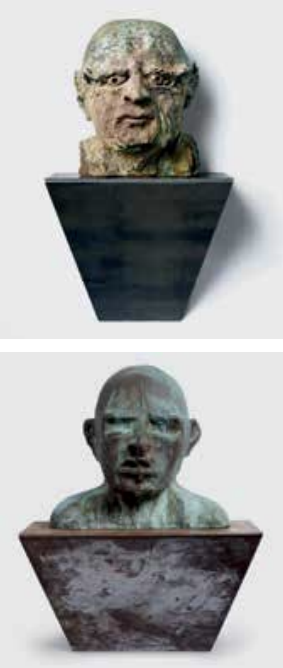
Wichte (Imps), 1954,
by Thomas Schütte.
From ancient Egypt to the present, sculptors have turned to the human head to express nearly every emotion conceivable: power, faith, memory, vulnerability. George Petrides' Hellenic Heads enter that long tradition as a deliberate confrontation. The series adopts the format of the monumental head—usually reserved for pharaohs, gods, heroes, and leaders—and fills it with the inherited fears and strengths of a specific Greek family marked by war, displacement, and transformation. It both aligns itself with and diverges from the sculptures of the Pharaonic world, from Phidias and Michelangelo, from Rodin, Brancusi, Giacometti, Bourgeois, and Schütte.
In person, the heads assert themselves before they explain themselves. The series' six busts, each approximately three feet (90 cm) in height, are placed on pedestals to achieve a total installation height of over two meters (6.5 feet). Set in rows or loose clusters, they are scaled to be taller than almost all viewers, occupying space like historic monuments yet asking not for allegiance but for recognition. At a distance, they read as clear silhouettes; up close, the uneven textures of skin, hair, and scarred surface make their histories tangible. They convey not only psychological content but also weight, mass, and the physical pleasure of modeling: clay-like ridges, sharp cuts, softened planes. Installed outdoors, the works register weather and changing light; indoors, raking illumination pulls every tool mark into focus.
Pharaonic Precedents: Authority and Fracture
The surviving Pharaonic sculptures of ancient Egypt are among the earliest ancestors of Hellenic Heads. Nefertiti’s painted bust (c. 1345 BC, discovered in 1912 and now in Berlin) has become the canonical image of ancient beauty—poised blue crown, elongated neck, and balanced features—yet its slight asymmetries and firm jaw still suggest a specific, observed person rather than a generic ideal. As the program image of the Amarna revolution, it embodies Akhenaten’s radical experiment in monotheistic sun-worship and likely served as a workshop model for her standardized image.¹ In reliefs, she appears alongside Akhenaten performing kingly acts, feeding the view of her as co-regent or even a quasi-pharaonic figure with shared royal power. The bust’s calm frontality and contained authority condense that shared power into a single, charged head.
Petrides borrows from these works the sheer fact of command: his heads, like theirs, are felt physically before they are interpreted. But the resemblance ends there. Where the Pharaonic heads erase doubt and imperfection to demonstrate the power of the absolute monarchy, Petrides' surfaces admit fracture and roughness. Tool marks, asymmetries, and abrasions remain visible. Each Hellenic Head carries layered, sometimes contradictory messages: pride and shame, fear and resilience, beauty and damage. The earlier monuments stabilize identity; Petrides shows what it is like when identity is unsettled by history and migration, yet still capable of composure and dignity. In effect, the Egyptian head idealized an eternal king or queen, while Petrides' heads expose the vulnerable humanity of those who endured the tumults of the 20th century and survived.
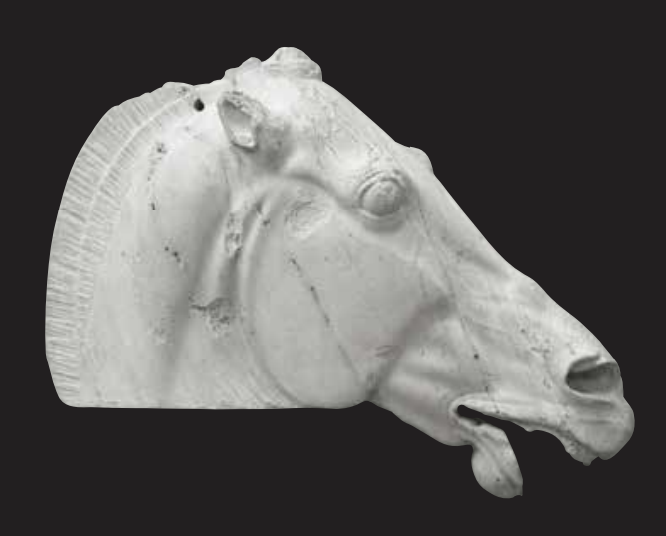
Head of a horse of Selene,
5th c. BC (438–432 BC),
marble sculpture from the east
pediment of the Parthenon,
believed to have been designed
by Phidias. The British Museum.
Melissa Publishing House
Photographic Archive.
Michelangelo: The Engine of Decision
Michelangelo’s David (1501–1504)—considered here through the head alone—offers another kind of ideal. The head is famously beautiful, but it is not empty. The furrowed brow, tight lips, and focused gaze capture a moment of concentrated thought just before action: the dominant scholarly view holds that David shows the hero before, not after, the battle with Goliath. (Earlier Renaissance sculptors like Donatello had shown David victorious, standing over Goliath’s head; Michelangelo’s choice to depict the tense instant before the fight was revolutionary.)⁴ The head is the engine of decision, the seat of the intellect and concentration that will win the victory. This psychological focus is underscored by the sculpture's proportions: David’s head and hands are slightly oversized relative to his body, a deliberate emphasis on intellect and resolve over brute force.⁵
Petrides' heads also prioritize the inner life over anatomical perfection, but they refuse Michelangelo’s idealization. Skin is not flawless; features are slightly skewed; hair is suggested rather than polished into ringlets. Where Michelangelo enlarges the head to make a single, decisive psychology legible, Petrides enlarges it so that decades of experience, including memories of conflict and scarcity, can be inscribed in forehead, cheek, and jaw. David captures a moment: the youth before the battle, filled with potential, his story still ahead of him. Petrides' figures stand mostly after an entire arc of events: after war, displacement, hunger.. Their scale and upright bearing suggest endurance: lives rebuilt, families raised, work continued despite what came before. Both works trust that a head alone can carry a narrative, but in David that narrative is linear and triumphant, whereas in Hellenic Heads it is recurrent—an inherited trauma that returns across generations unless someone chooses to interrupt it.
Monumental Head of Pierre de
Wissant, Bronze, by Auguste
Rodin ca. 1884–1885. North
Carolina Museum of Art.
Untitled, Louise Bourgeois.
Brancusi and Giacometti: Essence and Fragility
In the early twentieth century, Constantin Brancusi and Alberto Giacometti strip the head almost to its essence. Brancusi’s Sleeping Muse (1910) reduces the face to a polished ovoid with only the barest traces of features, hovering between portrait and a single, universal "archetype".⁷ Giacometti’s Grande tête mince (Large Thin Head, 1954) pushes in the opposite direction: the head is stretched and thinned into a narrow "knife-blade" plane, more shard than conventional bust, embodying a "haunting" and "dislocating" sense of existential fragility.⁸ (Notably, this work was conceived in the context of Existentialist thought in 1950s Paris and is often seen as an expression of postwar alienation and anxiety.)
Petrides' heads occupy a middle position between these extremes. Like Brancusi, he simplifies: features are generalized, textures unify large areas, and detail is restrained so the whole form reads clearly. Like Giacometti, he embraces elongation and imbalance; some heads feel slightly too thin, too tall, as though stressed by time and experience. Yet Petrides insists on specificity. Where Brancusi and Giacometti give us an essence of “Woman” or “Man” in general, Petrides ties the monumental head to a genealogy and a map, making broad themes answerable to concrete history. In short, Brancusi and Giacometti turned the human head into an absolute form; Petrides finds meaning in the head as a vessel of lived memory, somewhere between the universal and the personal.
Schütte: Monumentality and Its Discontents
Thomas Schütte’s engagement with authority and monumentality offers another contemporary parallel, particularly in his series of sculpted heads such as Wichte (Imps). These works revive the monumental portrait bust only to make it ambiguous and uneasy. The heads, often set on high shelves, glare down at the viewer "like a row of authoritarian figures," yet they are “brutalised, grotesque faces” that “mock power”; their “hieratic bearing” is undermined by caricatured, deformed features.10
Petrides shares with Schütte a fascination with what happens when the human figure is enlarged beyond its natural scale. Like Schütte, he is alert to the ways sculpture can embody the state or challenge it. But Petrides chooses a different subject and a different ethic of surface. Where Schütte gives us “grotesque faces”—generalized figures of authority whose hollowness is the point—Petrides gives us grandparents and parents whose authority is fragile and sometimes compromised, yet whose endurance has made a different future imaginable. Schütte’s monumentality is ironic, exposing the emptiness of state power. Petrides' monumentality is earnest, honoring the quiet work of survival. In Wichte, monumentality itself is undermined and mocked; in Hellenic Heads, monumentality is embraced but transformed—turned toward the commemoration of resilience rather than conquest.
Coda: A New Turn in an Old Argument
Across these comparisons,the Hellenic Heads emerge as both rooted in sculptural history and distinctive in purpose. The Pharaonic heads, the Parthenon sculptures, and David used the human figure to project ideals—divine order, civic harmony, heroic virtue. Rodin, Brancusi, Giacometti, Bourgeois, and Schütte questioned those ideals, turning the figure inward or exposing its entanglement with politics, spectacle, and trauma.
Petrides adds another turn to this ongoing debate. He accepts the risk of monumentality but changes its subject. Instead of honoring a conqueror or illustrating a myth, Hellenic Heads honors those who lived through the consequences: those who queued for bread, who packed a single suitcase, who did not explain to their children why they flinched at certain sounds, and who nonetheless rebuilt lives. It uses the ancient language of stone and scale not to celebrate victory but to make visible the quiet work of survival. This act gives form to the effort not to pass wounds on intact—a form of what theorists of “postmemory” have described as the fraught transmission of trauma from one generation to the next.11 Petrides stands alongside the sculptors he invokes, not as an imitator but as a serious interlocutor—asking, in our own time, what the sculpted head can be asked to carry, and what kind of future might be possible if we choose to look it in the face. Each of his heads insists that personal history is history, that memory deserves its monument, and that even wounded faces can stand as arguments for resilience. In an era when monuments are being reconsidered and redefined, Petrides offers a compelling new answer in an ancient form: a monument to vulnerability, endurance, and the human head that carries them.
———————————————————————
¹ On the Nefertiti Bust (c. 1345 BC) as an icon of authority and its status as a possible workshop model, see Neues Museum, Berlin, “Bust of Nefertiti,” Collections Online. For Nefertiti’s status as co-regent, see Google Arts & Culture, “An Audience with Nefertiti,” Neues Museum.
² For the Parthenon’s sculptural program, see Joan Breton Connelly, The Parthenon Enigma (New York: Alfred A. Knopf, 2014).
³ British Museum, “Head of a horse of Selene from the east pediment of the Parthenon,” Collections Online. For the canonical interpretation of the horse's “exhaustion,” see Getty Museum, “Studies of Horses (after the Parthenon Frieze),” Collection Online, which notes, "the horses of Selene, goddess of the moon, were described as tired from pulling her chariot at the end of their nightly journey".
⁴ The interpretation of David (1501–1504) as depicting the moment before the encounter with Goliath is the dominant scholarly position. See Accademia.org, "Facts About David", and Context Travel, "Ten Facts About the Statue of David". Michael Hirst, Michelangelo and His Drawings (New Haven: Yale University Press, 1988) remains a foundational text on the artist's process.
⁵ For analysis of the head's "furrowed brow" as the "seat of thought" and the oversized proportions as an "emphasis on intellect," see The Introvert Traveler and the Galleria dell’Accademia, “David,” collection entry, Galleria dell’Accademia, Florence.
⁶ On Rodin’s individual head studies, such as the Monumental Head of Pierre de Wissant (modeled c. 1884–85), see the North Carolina Museum of Art and Brooklyn Museum collections. For "anti-monument" as a framework for Rodin's Burghers, see The Guardian and The New York Public Library. The artist George Petrides has also publicly discussed this work as an "anti-monument to the civilian who was suffering".
⁷ On Brancusi’s Sleeping Muse (1910) and the ovoid head, see The Metropolitan Museum of Art, “Sleeping Muse,” Collections Online. For the ovoid form as "archetype," see Centre Pompidou, "Brancusi Podcast Transcription" and "The Endless Life of Constantin Brancusi".
⁸ For Giacometti’s Grande tête mince (1954) in relation to postwar existentialism, see Fondation Giacometti, Paris, and Christian Klemm et al., Alberto Giacometti (New York: Museum of Modern Art, 2001). Sotheby's analysis of the work notes its "haunting," "dislocating" "knife-blade" quality.
⁹ On Bourgeois’s fabric heads, see Irish Museum of Modern Art, “Untitled” (2001), and The Easton Foundation.
10On Schütte’s Wichte (Imps) series (c. 2006) as “brutalised, grotesque faces” that “mock power,” see Pinault Collection, “Wichte”, and Museo Reina Sofía, “Wichte (Imps)”.
11Marianne Hirsch, The Generation of Postmemory: Writing and Visual Culture After the Holocaust (NewYork: Columbia University Press, 2012). For the specific application of postmemory to Greek and Asia Minor diasporic trauma, see PMC and Peri-technes.