Kore 684 (ca. 490 BC) Acropolis Museum,
Athens, Greece
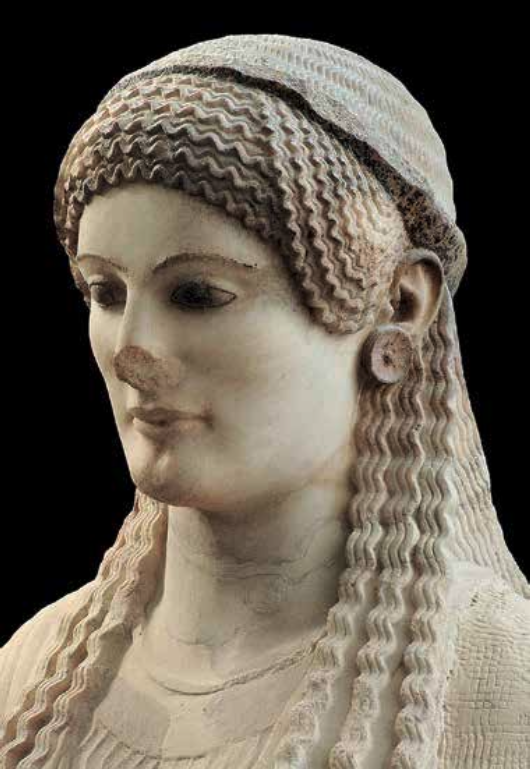
Detail of the Kore 684 with a
particularly elaborate hairstyle and
expressive features, accentuated
with paint (ca. 490 BC). Acropolis
Museum, Athens, Greece. Photo
by Socratis Mavromatis.
For the final sculpture in this 2,500-year journey, representing Modern Greece (1950-2025) I selected a sculptural precedent I first encountered during childhood visits to the old Acropolis Museum (on the Acropolis itself) with my aunt Emmanuela, an archaeological guide. Decades later, I reconnected with this piece, Kore 684, at the new Acropolis Museum which opened in 2009, including with the intention of receiving the Parthenon Marbles which are being held at the British Museum in London, UK.
Kore 684 depicts a maiden, dated to approximately 500 BC. The statue is understood to be a votive offering dedicated to the goddess Athena, originally placed on the Acropolis near the Parthenon. With the Persian invasion of 480 BC, it was buried by the returning Athenians in a ceremonial clearing of the sacred site. This "Perserschutt" (Persian debris) became a time capsule, preserving it and dozens of other sculptures until their rediscovery during excavations in the late 19th century.
This statue is a prime example of the korai (maidens), a hallmark of the Archaic Period (c. 600–480 BC) and the female counterparts to the nude kouroi (youths). Korai are always depicted clothed, displaying formal, upright postures, intricate clothing, and stylized hair. Traces of vibrant polychromy (color) are still visible on this one and many others, proving they were not originally white marble. A defining feature is the "Archaic smile," an artistic convention deemed to signify divine grace and vitality rather than a specific human emotion. Other notable korai are housed in the National Archaeological Museum in Athens and the Louvre.
With this wonderful sculpture as my precedent, I asked my daughter, Sofia, then 12 years old, to pose. My sculpture, Kore, incorporates the enigmatic smile with my daughter's characteristics. It is the only sculpture in the Hellenic Heads series that looks upward. I hope this piece conveys the optimism that a young person may feel for her future, and that a nation and its people may feel for theirs.