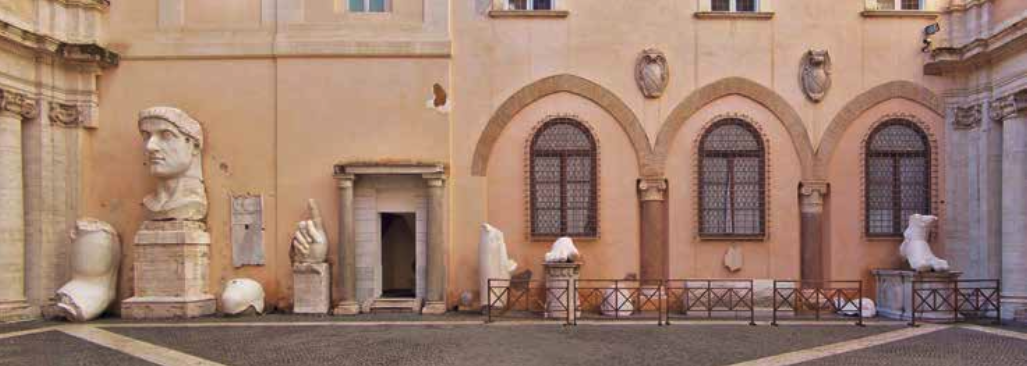
Colossal Head of
Constantine the Great (313–324)
Musei Capitolini / Palazzo dei
Conservatori, Rome
Colossal head
of Constantine the Great
(ca. 313–324). Capitoline
Museums, Rome.
For the Byzantine Empire, I found two heads, colossal heads of Constantine. The first of the heads is from the Colossus of Constantine, the surviving fragments of which are now housed by the Capitoline Museums in Rome. The remaining pieces were carved from white marble, while the rest of the body was made of brick and wood and possibly gilded, which was subsequently pillaged. According to Michael Grant: “Here was the man at whose court...writers felt it appropriate to speak of the ‘Divine Face’ and ‘Sacred Countenance’. The sculptor has conceived this countenance as a holy mask, an overpowering cult object resembling, though on a far greater scale, the icons of future Byzantium: an idol animated with the divine presence, and with the power to repel the demons lurking in pagan images.”6 The fragments include two different right hands, and according to Wikipedia, it is thought “that the statue was re-worked at some time late in Constantine’s reign and a hand holding a sceptre was replaced by a hand holding a Christian symbol.”7 The 8-foot tall head was perhaps meant to convey the other-worldly nature of the Emperor, notable in its enormous eyes which gaze toward eternity from the more typically rendered stiff face.
Another, marble head is held by the Metropolitan Museum in New York, and probably also originated in Rome. According to the Met website, “the long face, neatly arranged hairstyle, and the clean-shaven appearance of this portrait head are a deliberate attempt to evoke memories of earlier rulers such as Trajan, who in the later third and fourth centuries was seen as an ideal example of a Roman emperor. Certainly, by the time that the head was set up, as part of either a bust or, more probably, an over life-sized statue, Constantine had adopted an official image that was intended to set him apart from his immediate predecessors.”8 As I worked on my version of the sculpture, I found that it took on characteristics of my father. The name, Archon, could be said to be a leader or a noble person and that is how I think of my father’s character. Sadly, he passed away in 2017, but I’ve captured, I think, some of his qualities in this work.
——————
6. Grant, Michael (1970), The Roman Forum, London: Weidenfeld & Nicolson; Photos by Werner Forman, p. 161.
7. Wikipedia contributors. (2022, July 21). Colossus of Constantine. In Wikipedia, The
Free Encyclopedia. Retrieved 18:07, July 24, 2022, from https://en.wikipedia.org/w/index.php?title=Colossus_of_Constantine&oldid=1099616216
8. Retrieved July 24, 2022, from www.metmuseum.org.
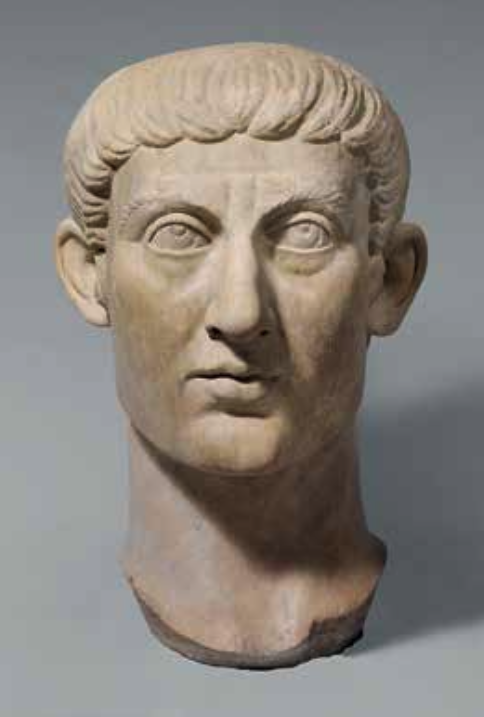
Marble portrait head of the
Emperor Constantine,
(ca. 325–370). The
Metropolitan Museum
of Art, New York.