Rondanini Pietà (1564) by Michelangelo
Castello Sforzesco, Milan
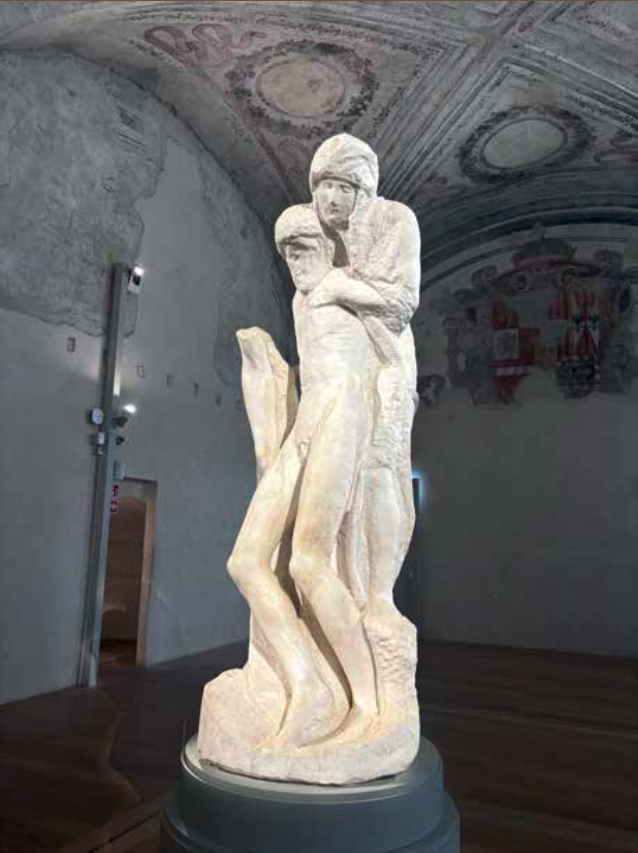
Rondanini Pietà (1564), by
Michaelangelo. Castello Sforzesco,
Milan. Photo Julius Barclay - Own work.
I have long been astounded by - and sought to learn from - the human being would excel in so many different fields (drawing, sculpture, painting, architecture, poetry - he was even an astute businessman) can only be described as genius. In addition to studying the lectures of William Wallace, the exhibitions of Carmen Bambach, the novel of Irving Stone (and entertaining movie that came out of it), I have been fortunate to experience his sculpture, painting and architecture in person. As a sculptural precedent for The Refugee, given that the first name of my maternal Grandmother - who was a refugee from Smyrna - was Maria, I was drawn to the three Pietà sculptures made by Il Divino over the course of six decades: the Madonna della Pietà (1498–1499) in Rome; the four-figure Deposition of Christ (1547–1555) in Florence and the Rondanini Pietà (1552–1564) in Milan. Each can be said to have served as a sculptural precedent for The Refugee, however, I will single out the Rondanini.
Wikipedia: “The Rondanini Pietà was begun before The Deposition of Christ was completed in 1555. In his dying days, Michelangelo hacked at the marble block until only the dismembered right arm of Christ survived from the sculpture as originally conceived. The elongated Virgin and Christ are a departure from the idealised figures that exemplified the sculptor's earlier style… The unfinished quality of the work fits with Michelangelo's late progress away from naturalism and humanism and toward a mystical Neoplatonism, in which he conceived of a sculpture as latent in the marble and requiring merely the removal of superfluous material; in this manner, he seems to have deprived his human symbols of corporeal quality in an attempt to convey directly a purely spiritual idea.”
In addition to the expression of the Virgin Mary, I was drawn to the rough texture that Michelangelo left over the whole surface of the large sculpture. Did he leave it this way because he “ran out of time” or was this intentional? Wikipedia: “It has also been suggested that the sculpture should not be considered unfinished, but a work in a continuous process of being made visible by the viewer as he or she moves around to see it from multiple angles.”10
——————
10. Wikipedia contributors. Rondanini Pietà. In Wikipedia, The Free Encyclopedia. Retrieved 1:37 PM, October 17, 2024, from https://en.wikipedia.org/wiki/Rondanini_Piet%C3%A0#External_links